A read-aloud story · 5 min
The Night the Stars Took Turns
Early readers · Richer words and bigger questions — great to read together. About 5 minutes.
Hands full? Auto-scroll is under Aa. Listen is part of Stories Nest Pro.
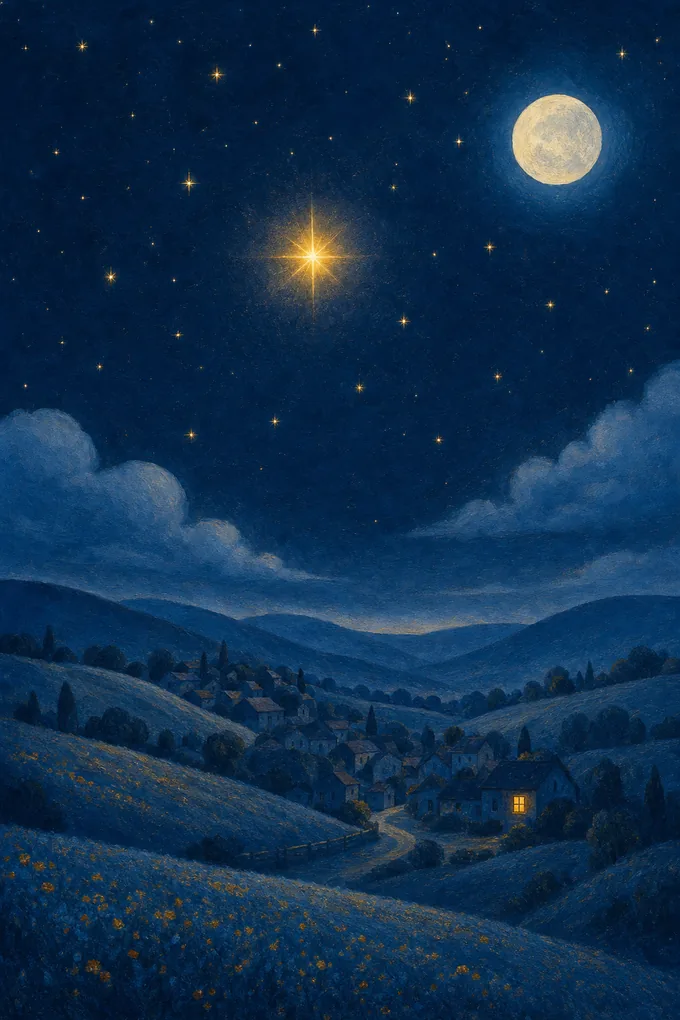
Long ago — long before anyone you know was born, before even the oldest tortoise was a tortoise at all — the stars did not twinkle. They shone. All of them, all night, as hard as they possibly could, every single star at once. Imagine the glare.
Nobody remembered who had started it. Each star simply worried that if it rested, even for a blink, the sky might forget it was there. So they all burned steady, side by side, from dusk until dawn, and the night was as white as noon.
It was beautiful, in the way a shout is loud. But nobody below could sleep. The owls lost midnight. The poppies never closed. The moths were beside themselves, in love with everything at once. The field mice lay in their burrows with their paws over their eyes, and even the sea stayed up all night, fussing and turning over.
And the stars themselves grew tired. Shining always, it turns out, means shining thinner and thinner. By winter they had dwindled to a pale fizz, and some went out for whole nights at a time, and the sky those nights was as dull as a closed cupboard.
The Moon watched all of this, the way she watches everything. The Moon knew something the stars did not, because she practiced it every month: how to grow thin, and rest, and come back round and bright as a coin. So she called the first great Meeting of the Sky.
The stars gathered, glaring and exhausted. The Moon waited for quiet — the way the Moon waits, which is completely. Then she said, “Friends. What if you took turns? Shine, and rest, and shine.”
“Turns!” huffed the biggest star, who hadn’t rested in nine hundred years. “And while I rest, who will they look at?” “Your neighbor,” said the Moon. “And when your neighbor rests, they will look at you. The sky is not a window with room for one face.” The big star grumbled — but he tried. He dimmed for one count, then burst back out at two. “I might have been FORGOTTEN,” he cried. That, the Moon observed, was not rest.
Next the twin stars tried. Each promised the other a turn, but both counted too fast. “Seven-eight-nine-TEN!” they squeaked in one breath, and flared at the same moment, and the sky became a bright, blinking muddle. Each twin accused the other of cheating. Possibly both were right.
Then a small, flickery star named Glim spoke up. “We’ll count for each other,” she said. “Slowly. Nobody counts their own turn.” She turned to her neighbor. “Shine, and rest, and shine.” Glim counted ten slow counts while her neighbor rested. Then, though her light trembled, Glim leaned back into the dark and closed her eyes.
Her neighbor counted for her. One… two… three… Nobody forgot Glim. At ten she opened her eyes, rested and luminous, glowing twice as bright as before. And the dark, she reported, was cool and soft, like the underside of a pillow, and you could lie back in it and listen to the comets go by, the way you listen to trains at night.
Star by star, the turn-taking spread across the sky in a slow silver ripple. Each star counted for another, so every turn was witnessed and every rest was real. Even the biggest star waited all the way to ten. From far, far below, each little hand-over looked exactly like a wink.
And the night went soft again — dark enough for sleeping, bright enough for finding your way home. The poppies closed. The owls got their midnight back. The sea calmed down, and has only fussed a normal amount ever since.
So that is why the stars twinkle. Each flicker is one star handing the sky to its neighbor, polite as you please, and settling back into the dark for its turn to rest. Tonight, pick one star and watch. There — did you see it? You caught the exact moment of the hand-over.
Somewhere above your roof, right now, Glim is closing her eyes, and her neighbor is keeping count. She has been shining all evening, just for you. Now it’s your turn.
Talk about it
A why-story about sharing the sky: taking turns is how everyone gets to shine, and rest is part of the shining.
When is waiting for your turn hardest for you? What helps?
The stars found out that resting made them brighter. What does a good rest do for you?
If you could whisper goodnight to one star tonight, what would you tell it?
One more? Try a five-minute puppet show, or pick another story below.