A read-aloud story · 6 min
The Kite That Learned to Fall
Early readers · Richer words and bigger questions — great to read together. About 5 minutes.
Hands full? Auto-scroll is under Aa. This full-cast recording with sound effects plays free for everyone.
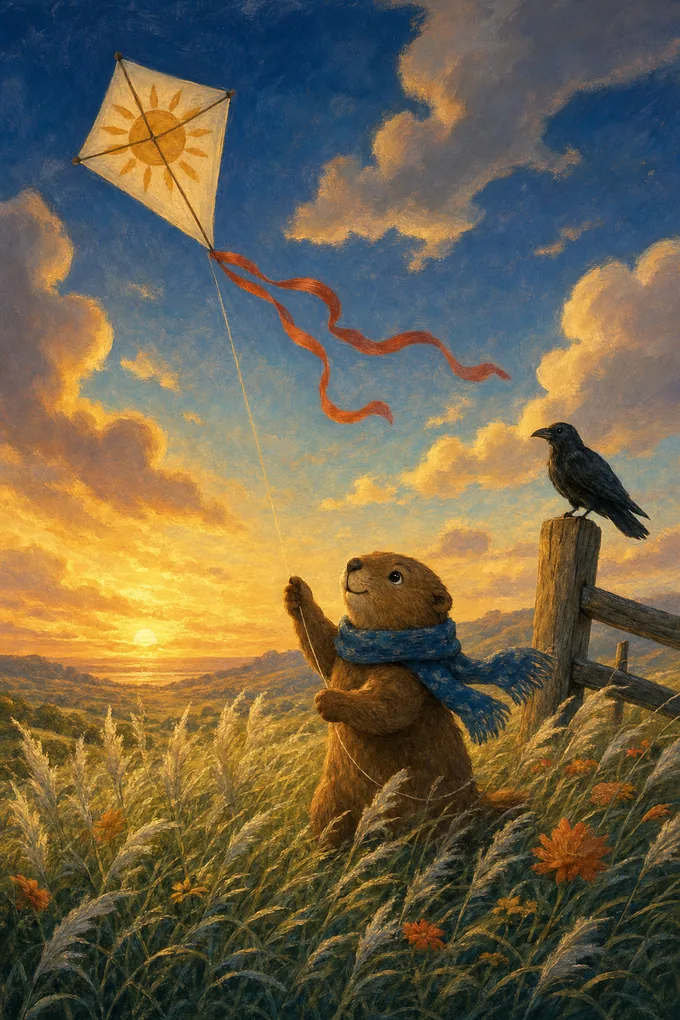
Milo the marmot built his kite on a windy-bright morning, out of butcher paper, two birch sticks, and a very large amount of confidence. He painted a blazing sun on the front, wound forty tail-lengths of string around an old thread spool, and checked every knot with meticulous care: tug, squint, tug. It was his only sheet of paper. By dusk, it would fly.
The wind was there first, combing the meadow grass. Milo ran. The kite leapt off his paws — up, up — and then it somersaulted like a dizzy dragonfly and stitched itself, nose-first, into the green. Whump. Three field mice ducked. Milo wished he could duck underground too, but the string led straight back to him.
Something hot and prickly climbed the back of Milo’s neck. He stomped over. The kite was fine. Behind Milo’s ribs, however, something had crumpled. And then a scratchy voice drifted down from the fence.
On the post sat Professor Caw, an old crow with a voice like a squeaky gate. “Hm,” said the crow. “Even the wind likes something to hold on to.” And he flapped away, explaining nothing, because crows never do — not when a riddle will serve.
Milo scowled at the kite. The kite lay there, tailless. Tailless. Of course. He braided a long tail from meadow grass and knotted one red ribbon at the end of it, and while his paws worked, the heat in his neck cooled into a hard little promise. “Watch. Mend. Try once more.”
The second flight did not crash. It never got high enough to crash. The wind, capricious as a kitten, had wandered off somewhere, and no matter how hard Milo ran — and he ran until his ears flapped — the kite only bumped along behind him like a paper dog. He sat down hard in the grass. Perhaps flying was an unfair trick the sky played on ground animals.
“The grass,” said Professor Caw, from nowhere, “knows the wind’s plans before the sky does.” Milo looked up just in time to see black wings lift. Squeak. Flap. Gone. Another riddle, dangling over his head.
So Milo lay on his back and watched. When the grass stood still, the sky was closed. When it bowed and turned silver, the sky was open. Waiting made his toes twitch, but while he waited he untangled the tail and whispered, “Watch. Mend. Try once more.” Then the blades bowed low, and Milo sprang up and ran.
The kite climbed. It truly climbed — tail streaming, painted sun flashing — and Milo held the string with every muscle he owned. Tight, tight, tight. The wind pulled; Milo pulled harder. It was HIS kite. He would not give it one inch. The kite stood on its nose and dove, and the field mice scattered like seeds. Crack. One birch stick snapped beneath the paper.
The prickle wasn’t a prickle now. It was a whole campfire. Milo growled at the sky, and the sky, being the sky, didn’t mind. Then he saw the thin red grooves across his paws. The string had told the truth: he had held too hard.
“A kite,” said Professor Caw, from the very top of the fence post, “is mostly patience with a string attached.” Milo opened his mouth to demand a sensible explanation, but the post was already empty. This time, though, he had all three clues.
He splinted the cracked stick with a straight twig and thread, binding it snug so it could bear the pull. He ate a dandelion sandwich and felt his feelings settle, one by one, like birds coming in to roost. Then he set the clues side by side: a tail for the wind to hold. Silver grass for the right moment. A string that must move. “Watch. Mend. Try once more.” Dusk gilded the meadow. The grass bowed low. Milo ran.
The kite wobbled. It dipped — his stomach dipped with it — and then, when the line tugged, Milo let the spool turn, giving a little, keeping a little, the way you pour something precious without spilling. Zzzzz. The tail swung round. The wind leaned in. And up it went, higher than the fence, higher than the hawthorn, small and bright and steady as a second sun. It flew, splinted stick and braided tail, and Milo could feel, in his paws more than his head, that every crash had gone up there with it.
He flew it until the first star pricked through. On the walk home, the mended kite under one arm, he passed Professor Caw. “I crashed three times,” said Milo. “Hm,” said the crow, settling his feathers for the night. “Only three?” Milo grinned into the dark. “Watch. Mend. Fly once more.”
Behind them the grass slowly stilled, and the red ribbon brushed Milo’s shoulder, and above the quiet meadow the first star and the paper sun shone together — while the sky closed gently behind them, like a storybook.
Talk about it
A story about how every crash carries an instruction, and how trying again works better once you’ve listened to it.
Which of Professor Caw’s clues helped Milo most, and what did it teach him to notice?
What happens in your body when something you are trying does not work?
Tell me about a time you changed your plan and tried again.
One more? Try a five-minute puppet show, or pick another story below.