A read-aloud story · 6 min
Old Tortoise and the Hurry
Early readers · Richer words and bigger questions — great to read together. About 5 minutes.
Hands full? Auto-scroll is under Aa. Listen is part of Stories Nest Pro.
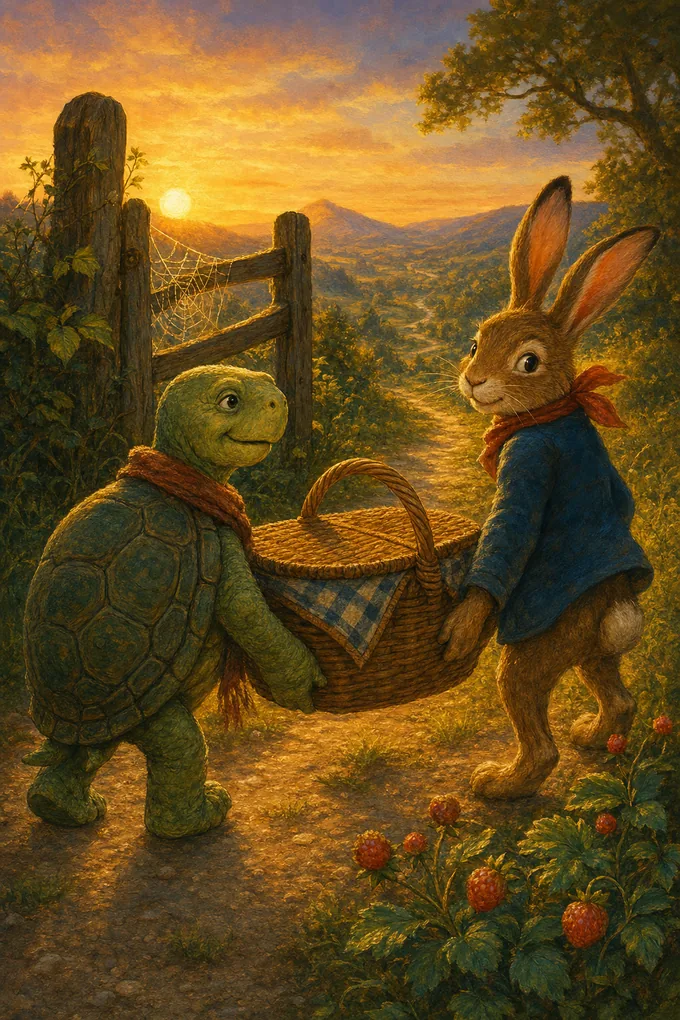
On the morning of the Long Table picnic, every animal in the valley set out carrying something. By old custom, nobody took a bite until the round seed-bread arrived. And the biggest basket of all — the one with two handles and the loaf tucked inside — went to Farrow the hare and Amble the tortoise, to carry between them, all the way to the far meadow, three hills away.
Farrow was young and made mostly of hurry. He ran everywhere: to breakfast, from breakfast, and sometimes around breakfast. Hurry was the family business. He took his handle at a sprint and got precisely nowhere, because the other handle belonged to Amble.
Amble was old — nobody knew how old, least of all Amble — and she walked the way warm honey pours: all one unhurried idea. She had three sayings. “Mm.” “Look at that.” And, for special occasions, “Well, now.”
“We’ll be late,” said Farrow, tugging his handle. His legs fizzed with go, and the basket hung between them like a slow anchor. Somewhere beyond the hills, the picnic bell would soon be ringing. “Mm,” said Amble, and walked.
The fizz climbed out of Farrow’s legs and buzzed in his chest. Being slow, he decided, was a kind of itching. A beetle overtook them. An actual beetle. Farrow gave one mighty tug — and the basket lid jumped.
Thump. The seed-bread bounced out and rolled for the ditch. Farrow flashed underneath it and caught it on both paws, quick as anything. Not one seed fell off. His ears burned anyway as he tucked the loaf back in. Fast, it seemed, could rescue what fast had spilled. Then Amble stopped.
“Look at that,” she said. Pressed flat into the dried mud of the path, burnished bright as a tiny sun, lay a brass button. Farrow bent close — and his ears went straight up. It was his own button, off his good green coat, lost since last spring. “I’ve run this path a thousand times,” he said slowly, turning it over. “Mm,” said Amble, and walked.
Farrow pocketed the button and followed. And this time, he looked at the path almost as often as he looked at the far meadow. At the second hill, Amble stopped beside a low tangle of leaves.
Underneath — exactly at tortoise height — hung wild strawberries. Not the hard pink kind that squeak, and not the soft brown kind that sulk. Plump, succulent, warm from the sun, today of all days. “Well, now,” said Amble. Farrow completely forgot to mention the bell.
They ate one each, right there, and the taste was so loud that Farrow had to sit down. Then they picked a hatful for the basket. His paws went red to the wrists, and he did not hurry them. “Mm,” said Amble, and walked.
The third stop, Farrow found himself. On a dock leaf by the stream path, a ladybird lay stuck on her back, six indignant legs bicycling at the sky. One gentle flip of one hare-paw and off she flew — a red spark going home — circling their heads once on the way, as if to say so. And then, faint across the valley, the picnic bell rang.
They arrived late. Properly late. Every face at the Long Table turned, and every plate was empty. “Did Amble make you slow?” somebody called. Farrow’s mouth opened around an easy excuse. His stomach gave a twist. “We both stopped,” he said. “And the third stop was mine.”
Then he lifted out the seed-bread and sliced it quick as quick, and passed the pieces down both sides of the table. The strawberries followed like a delicious rumor — the only basket with sun still warm in it — and the ladybird story got asked for twice, and Farrow kept touching the brass button, sewn back where it belonged.
Amble ate one lettuce leaf, slowly, from the outside in. “Mm,” she said, which at a picnic meant a great deal.
They walked home in the gold of the evening, the empty basket light between them. At the gate, it was Farrow — all by himself, nobody making him — who stopped to look at a spider’s web holding the low sun in every silver thread. “Look at that,” he said, in exactly the right voice. “Well, now,” said Amble.
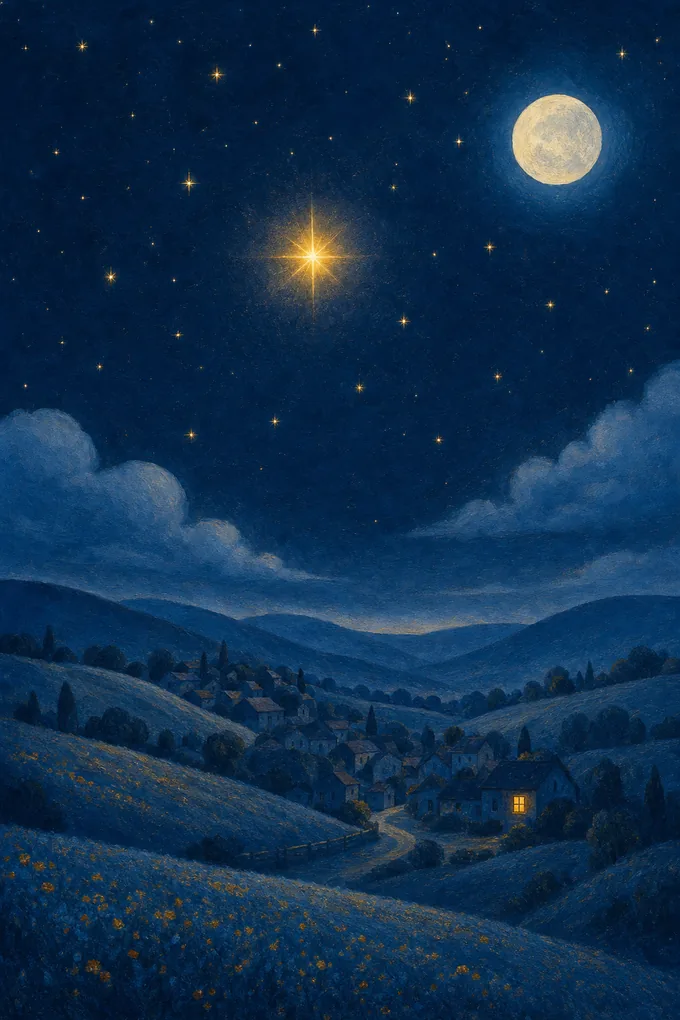
The valley went dim around them, one hedge at a time. Their four feet found one soft speed, and there was no hurry anywhere in it. And above the gate, in the very middle of the web, the first star waited.
Talk about it
A story about going at looking speed instead of getting-there speed, and what turns up when you do.
What did Farrow notice once he stopped using only getting-there speed?
When has hurrying made something harder for you?
Which of the three discoveries would you have loved most to find, and why?
One more? Try a five-minute puppet show, or pick another story below.